
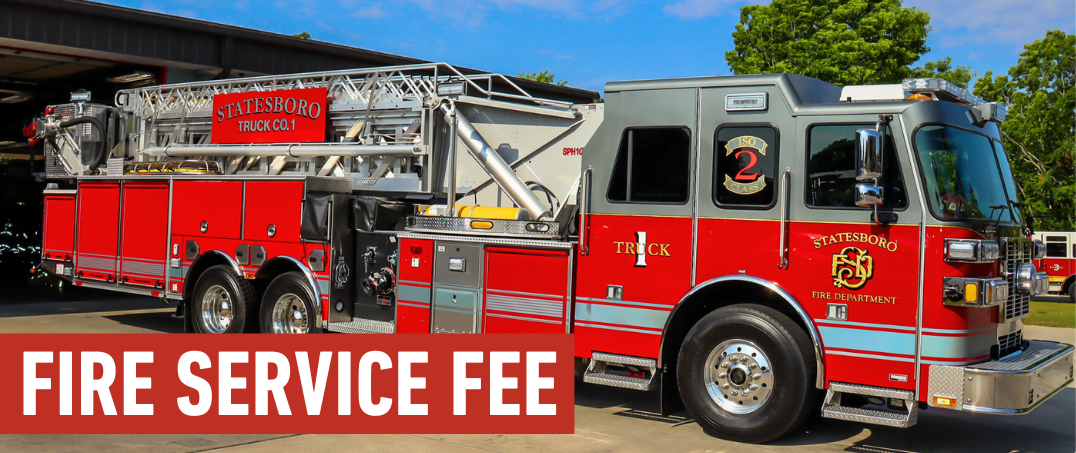
Proposed Fire Service Fee
The City is evaluating a proposed Fire Service Fee as a possible future funding mechanism for fire protection services within the City limits. This page provides background information, access to the public meeting recording, and answers to common questions.
The potential Fire Service Fee is part of a broader effort to ensure long-term, reliable funding for the Statesboro Fire Department. This evaluation focuses on maintaining current service levels, planning for future growth, and addressing equipment and operational needs.
The City has contracted with Goodwyn Mills Cawood (GMC) to perform research and analysis related to methodology and policies of a potential fire service fee for all properties in Statesboro.
Fee vs. Tax
Property taxes are based on assessed value and partially fund a wide range of City services. A Fire Service Fee would be structured differently. Because it is tied specifically to the cost of fire protection services rather than property value, it could broaden participation in funding fire readiness and emergency response to include properties that do not pay property taxes.
Approximately 23 percent of properties within the City are exempt from paying property taxes, including universities, schools, churches, and other nonprofit or governmental entities. The proposed fee would be paid by all property owners, including tax exempt properties.

How a Fire Service Fee Could Be Structured
If adopted, a fire service fee would be structured similarly to other City service-based user fees and would be based on property characteristics such as building area and land use, rather than property value. The methodology proposed is based on building area and land area, using the formula:
Fire Service Fee = (Building Area × Rate) + (Land Area × Rate)
Different rates would apply to residential, non-residential, and undeveloped properties, with monthly minimums and maximum caps.
Opportunities for Public Input
The City plans to host additional public information meetings before the Statesboro City Council considers whether to adopt a Fire Service Fee.
Details on future meeting dates, times, and locations will be shared on this website and through City communication channels. Residents, business owners, and stakeholders are encouraged to stay engaged and provide input as the process continues.
Questions and comments can also be directed via email to fire.department@statesboroga.gov.
Recording of Public Information Meeting held on Monday, February 9, 2026, at 6 p.m.
Frequently Asked Questions
What is a Fire Service Fee?
A Fire Service Fee is a service-based user fee adopted by many local governments in Georgia and neighboring states. Unlike property taxes, the fee is designed to align more closely with the cost of providing fire protection services and the benefits received by properties, including readiness, response capability, risk reduction, and prevention.
Why is the City evaluating this option?
The City is evaluating a Fire Service Fee to help address long-term funding needs for fire protection services as call volume increases, staffing expands, and operational costs rise. Fire Department calls within the City have increased by approximately 16 percent over the past three years, while the overall budget has grown significantly to maintain staffing, equipment, and service levels.
How did we get to this point with the budget?
In recent years, the Fire Department has relied on multiple funding sources in addition to the City’s General Fund to support operations and staffing. Two of those sources will not be available in the City’s FY2027. Those funding losses, combined with an increase in cost of services, will result in a $4.3 million fire funding gap for FY2027.
1. Five-Mile Fire District (Special Service District)
The Bulloch County Board of Commissioners voted to end the Five-Mile Fire District agreement with the City of Statesboro effective June 30, 2025.
In FY2025, the Special Service District generated $2,755,840 in revenue to support Fire Department operations. That revenue is not reflected in FY2026 or FY2027 projections. This represents the loss of approximately $2.7 million in recurring annual funding.
2. Federal SAFER Grant
In 2023, the City was awarded a federal Staffing for Adequate Fire and Emergency Response (SAFER) grant to hire 12 additional full-time firefighters.
The grant provides $703,000 annually in funding for those positions. However, the grant is temporary and is scheduled to expire in 2026, after which the City must assume full financial responsibility for those firefighters if current staffing levels are maintained.
How would the fee be calculated?
The proposed fee would be based on property characteristics such as building area and land use.
The methodology proposed is based on building area and land area, using the formula:
Fire Service Fee = (Building Area × Rate) + (Land Area × Rate)
Different rates would apply to residential, non-residential, and undeveloped properties, with monthly fee minimums and maximum caps.
What could the fee look like for a typical household?
Based on sample calculations presented, the average single-family residential fee is approximately $18.92 per month, with most residential properties capped at $20 per month. Actual amounts would vary depending on building size and land area.
How is fire protection currently funded?
Fire protection is currently funded through a combination of General Fund revenue, grants, special service districts, fire line fees, and other limited sources. As some of these sources expire or fluctuate, the City is reviewing whether a Fire Service Fee could provide a more stable and equitable funding option.
How is a Fire Service Fee different from a property tax?
A property tax is based on assessed property value and partially funds a wide range of City services. A Fire Service Fee is tied specifically to fire protection services and is structured to reflect service demand and benefits received, such as reduced risk to life and property, increased property value, and lower insurance premiums.
Would businesses and non-residential properties pay more?
Non-residential properties generally generate a higher percentage of fire calls and typically require greater fire flow and response resources. As a result, non-residential properties would have higher average fees, based on building size and land area.
Will there be more opportunities for public input?
Yes. The City plans to host additional public information meetings before City Council considers whether to adopt a Fire Service Fee. Updates will be shared on this webpage and through official City communication channels.
Has a Fire Service Fee been approved?
No. The City of Statesboro is still in the evaluation and public engagement phase. No final decisions have been made, and Statesboro City Council has not voted to adopt a Fire Service Fee. If approved, the fee would go into effect on July 1, 2026.